

Other Fasteners
Cotter Pin
Accurate Fastners supplies cotter pins suitable for a range of industrial assembly applications where a reliable, removable locking element is required. Grades and sizes are confirmed on enquiry with our sales team.
- Standard
- —
- Grades
- On enquiry
- Size
- On enquiry
- Length
- On enquiry
Verification note: Product image supplied in the repository; this item is not listed in the brochure. Grades and sizes require confirmation.
Overview
What is the Cotter Pin?
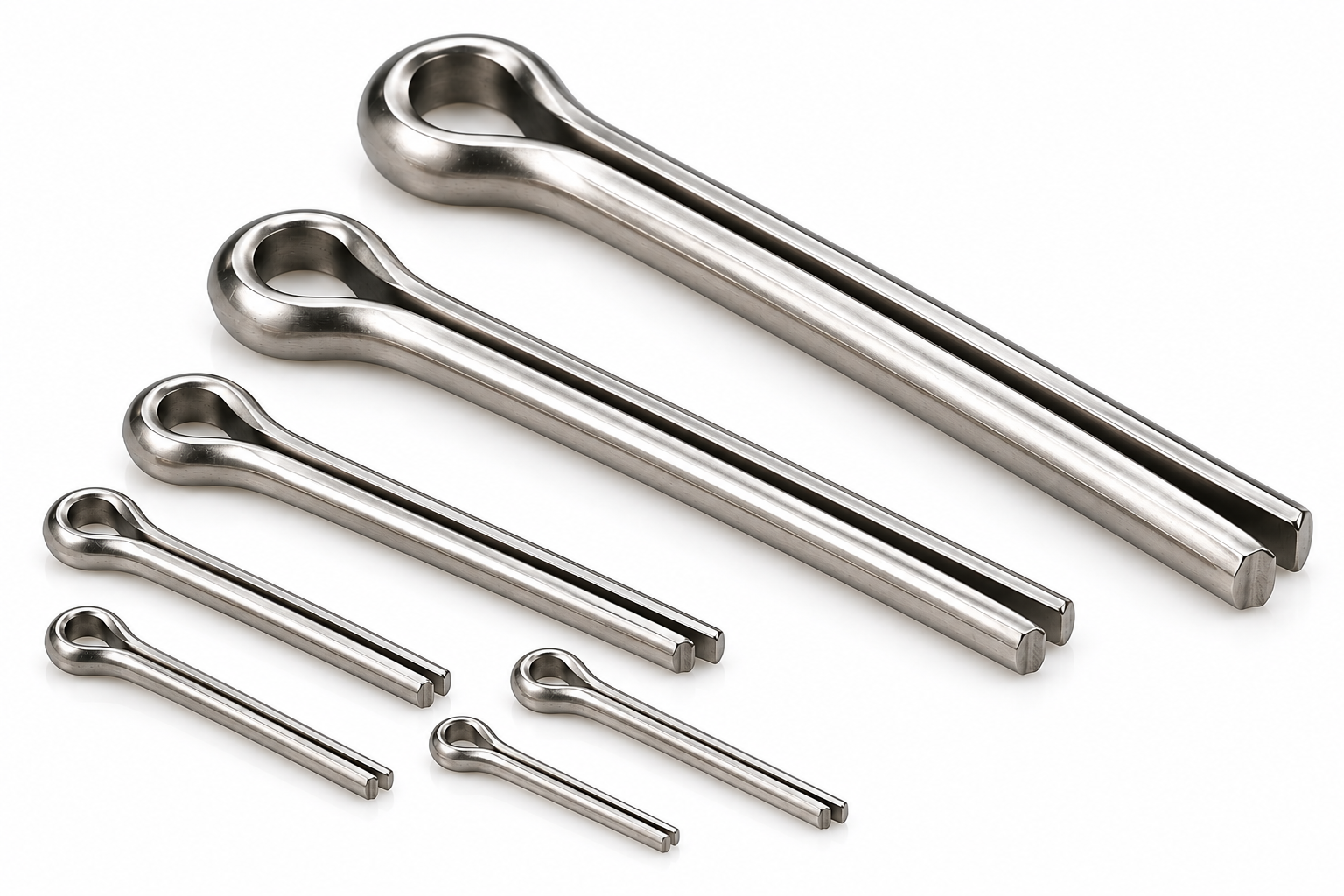
A cotter pin—also referred to as a split pin in British and Indian engineering practice—is a simple, non-threaded fastener used to secure other fasteners or components against unintentional loosening or axial displacement. It is inserted through a transverse hole in a shaft, bolt, or clevis pin, and its two legs are then spread apart on the far side to retain it in position. The design allows straightforward installation and removal without specialist tooling.
The cotter pin supplied by Accurate Fastners features a looped eye at one end and two flat, split legs extending from it. After insertion through the mating hole, the legs are bent outward—one typically folded over the fastener head and one along the shaft—creating a mechanical lock. This geometry means the pin cannot withdraw unless the legs are straightened and the pin deliberately pulled free, making it a useful secondary retention device in many assemblies.
Cotter pins are characterised by their low profile, light weight, and the fact that they are generally considered single-use items; once spread, the leg metal work-hardens and repeated bending may weaken it. They are available in a range of diameters and lengths to suit different shaft and hole configurations. Because grades and sizes for this product require confirmation, customers are encouraged to contact Accurate Fastners directly with their dimensional and material requirements before placing an order.
In Depth
Product description
Construction & Geometry
A cotter pin is formed from a length of wire or strip stock that is folded to produce a closed looped eye at one end and two parallel legs of equal or near-equal length at the other. The cross-section of the legs is typically semi-circular, formed by the fold, giving each leg a flat inner face and a rounded outer face. This shape allows the pin to sit neatly in a drilled hole without excessive play.
The eye serves as both a grip point during installation and a positive stop that prevents the pin from passing fully through the hole. Leg length and wire diameter together determine the range of material thicknesses and hole diameters the pin can accommodate. Because cotter pins are not threaded, no tapping or thread engagement is involved; their retention relies entirely on the mechanical interference created by the spread legs against the parent component.
Functional Behaviour in an Assembly
In service, a cotter pin acts as a secondary locking device rather than a primary load-carrying element. It is commonly inserted through a castellated or slotted nut and the threaded portion of a bolt or stud, preventing the nut from rotating loose. Alternatively, it may pass through a clevis pin to stop that pin from withdrawing under vibration or lateral movement. The pin itself carries relatively low shear loads and is not intended to replace primary fastening.
Installation typically involves aligning the pin with the transverse hole, pushing it through until the eye seats against the outer surface, and then bending the legs apart using pliers. One leg is usually bent back over the bolt end or nut face; the other may be bent downward along the shaft. This spreads the locking action over two directions and reduces the likelihood of the pin backing out under vibration.
How It Differs from Similar Fasteners
Cotter pins are sometimes confused with tapered or flat cotter pins used in older mechanical drives—those are solid, wedge-shaped components serving a different structural function. A split cotter pin (the type discussed here) relies on leg spreading, not wedging. They also differ from R-clips and hitch-pin clips, which use spring tension rather than permanent deformation for retention, meaning R-clips are more readily removable and reusable.
Compared with locking wire or thread-locking compounds, cotter pins offer a fully mechanical, visible indication of whether a fastener is secured and are straightforward to inspect. Unlike serrated flange nuts or nylon-insert lock nuts, cotter pins require a pre-drilled hole in the mating fastener or shaft, which must be specified at the design stage. Each locking method has particular assembly requirements, and selection depends on the specific joint configuration.
Material & Grade
Material and grade information
The material grades available for Accurate Fastners' cotter pins require confirmation with the sales team, as grades are not specified in the current verified product data. In general engineering practice, cotter pins are produced in mild steel, stainless steel, and occasionally brass or copper alloys, with the choice driven by the corrosion environment, assembly weight constraints, and compatibility with the mating components. Customers should specify their operating environment when enquiring.
Stainless steel grades such as 304 and 316 are commonly used in environments where moisture, mild chemicals, or food-contact conditions are a consideration, with 316 typically offering greater resistance in chloride-rich settings. For standard indoor or dry applications, carbon steel may suffice. As grade availability for this product must be verified, Accurate Fastners' sales team can advise on what is currently in stock or can be sourced to meet a particular specification or industry requirement.
Grades shown are those documented for this product in the Accurate Fastners brochure. General material notes are guidance only; confirm grade selection for your environment.
Technical Data
Technical specifications
| Product type | Fastener – Cotter Pin |
|---|---|
| Material | To be confirmed on enquiry |
| Material grade | To be confirmed on enquiry |
| Nominal diameter / size | To be confirmed on enquiry |
| Head / form | Looped eye with two split legs |
Sizes
Available sizes
Sizes for this product are not documented in our brochure. Please share your required diameter, length and quantity and our team will confirm availability.
Individual sizes within the documented range, thread pitches and lengths are confirmed at quotation stage.
Applications
Industrial applications
Submersible Pump Assemblies
Cotter pins may be used to secure castellated nuts on pump shaft bolts or retaining pins in impeller assemblies, helping to prevent loosening in wet, vibration-prone pump environments.
Solar Energy Mounting Structures
In solar panel racking systems, cotter pins can act as secondary locks on pivot bolts or clevis connections used for tilt-angle adjustment, reducing the risk of fastener migration over time.
Food & Beverage Processing Equipment
Machinery used in food processing may employ cotter pins in linkage and valve mechanisms where quick removal for cleaning or inspection is needed and a visible locking indicator is beneficial.
Pharmaceutical Machinery
Tablet press and filling machine linkages sometimes use split pins to retain clevis and pivot pins, allowing maintenance teams to disassemble and reassemble components without thread damage.
General Industrial & LED Lighting Fixtures
Hinged brackets and adjustable mounting arms in LED lighting installations may use cotter pins to secure pivot fasteners and prevent unintended movement during installation or servicing.
Features & Selection
Features and selection considerations
Design features
Looped Eye Design
The closed looped eye acts as a positive insertion stop and a grip point during installation, ensuring the pin seats consistently against the outer face of the mating component.
Dual Split Legs
Two parallel legs, each with a semi-circular cross-section, spread apart after insertion to create mechanical retention in two directions, reducing the chance of withdrawal under vibration.
Tool-Free Removal
Legs can be straightened with basic hand tools, allowing the pin to be withdrawn without damage to the parent fastener—useful where periodic disassembly for maintenance is required.
Visible Locking Indicator
The spread legs are readily visible on inspection, providing a clear physical indication that a fastener is secured, which may assist maintenance and quality-check procedures.
No Thread Engagement Required
Because cotter pins rely on hole insertion rather than threading, they introduce no risk of cross-threading or thread damage to the primary fastener or shaft they are used to retain.
Before you order
Pin Diameter & Leg Length
Match the pin wire diameter to the transverse hole diameter in the bolt or shaft. Leg length should be sufficient to wrap around the component after spreading without leaving excess that could foul adjacent parts.
Material Grade & Environment
Consider the operating environment—moisture, chemicals, temperature—when specifying grade. Confirm available grades with Accurate Fastners' sales team, as material options for this product require direct verification before ordering.
Mating Fastener Compatibility
Ensure the bolt, nut, or clevis pin has a pre-drilled transverse hole of compatible diameter. Castellated or slotted nuts must have slot positions that align with the hole in the threaded shank at the required torque.
Quantity & Documentation
For bulk or project orders, provide quantity, dimensional specification, grade requirement, and any applicable standard references. Accurate Fastners' quality control team performs checks during procurement and at delivery to support consistent supply.
FAQs
Frequently asked questions
What is a cotter pin used for?
A cotter pin is a secondary locking fastener inserted through a transverse hole in a bolt, shaft, or clevis pin. Its legs are spread to prevent the primary fastener from loosening. It is not intended as a primary load-bearing element.
Which grades are available for Accurate Fastners' cotter pins?
Grades are not currently listed in the verified product data for this item and must be confirmed with the sales team. Common stainless options in the industry include 304 and 316, but availability should be verified before placing an order.
What sizes can I order?
Sizes for this product are confirmed on enquiry. Please contact Accurate Fastners with your required pin diameter and leg length, along with the hole diameter and material thickness of the mating component, so the team can advise appropriately.
Is there a standard that governs cotter pins?
Cotter pins are covered by various standards including IS, DIN 94, and BS specifications. Accurate Fastners' fastener range is manufactured in compliance with IS, BS, and DIN standards where applicable; standard compliance for this product should be confirmed on enquiry.
Do I need to use a new cotter pin each time?
Cotter pins are generally regarded as single-use items. Once the legs have been spread and then straightened for removal, the metal may be weakened by work-hardening, and reuse is not typically recommended in engineering practice.
How can I request a quotation from Accurate Fastners?
Submit your requirements through the enquiry form on the website, email the team at export@accuratefastners.com, or contact via WhatsApp. Include pin diameter, leg length, quantity, grade preference, and any standard references to receive an accurate quote promptly.
Related Products
Complementary fasteners
Request a Quote
Request a quote for Cotter Pin
Tell us the grade, diameter, length and quantity you need. Your enquiry will be pre-filled with this product name.