

Nuts
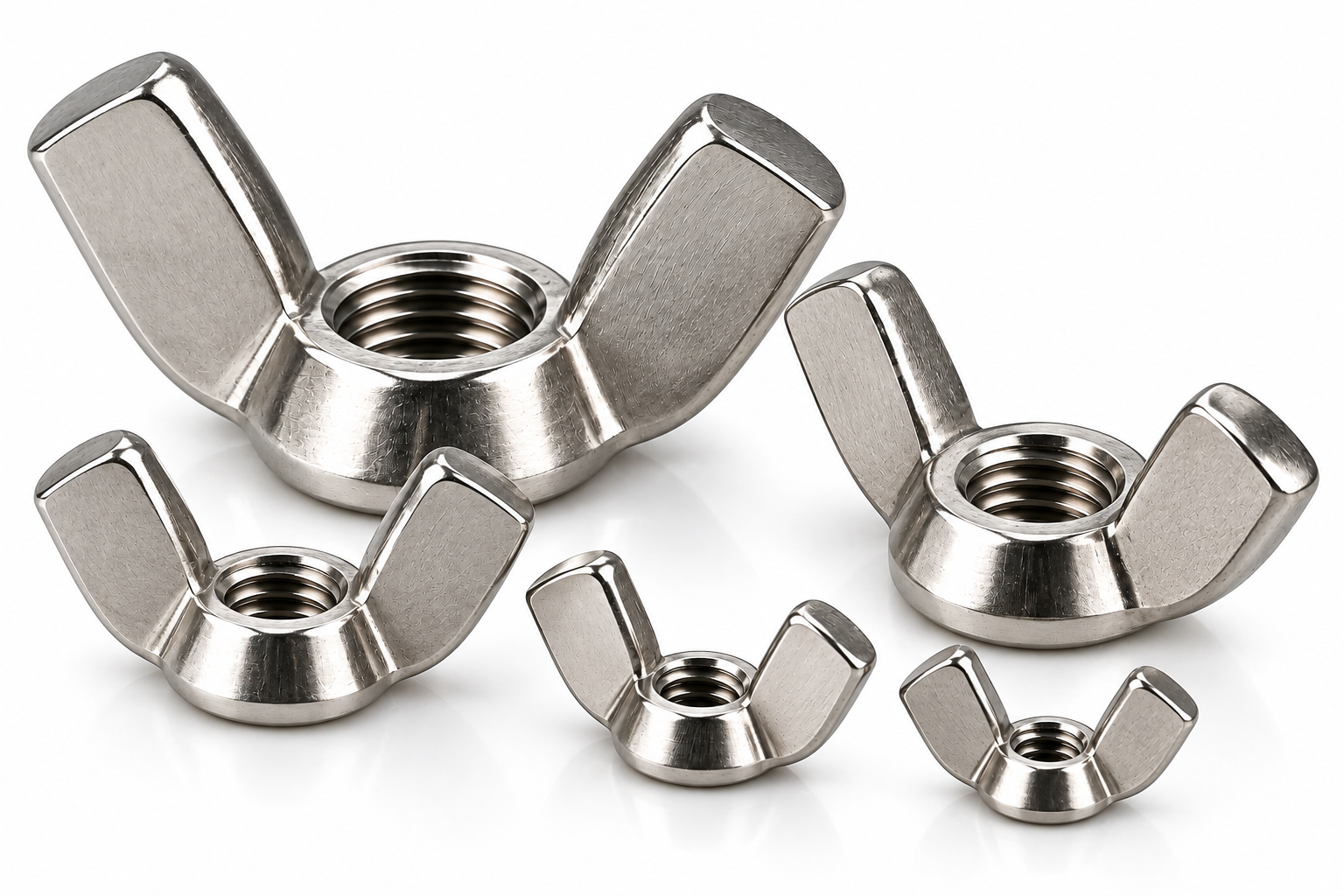
Wing Nut
Accurate Fastners, based in Ahmedabad, Gujarat, supplies wing nuts designed for rapid, tool-free assembly and disassembly across a wide range of industrial and commercial applications. Grades and sizes for this product are confirmed on enquiry with the sales team.
- Standard
- —
- Grades
- On enquiry
- Size
- On enquiry
- Length
- —
Verification note: Product image supplied in the repository; this item is not listed in the brochure. Grades and sizes require confirmation.
Overview
What is the Wing Nut?
A wing nut is a threaded fastener with a standard internal metric thread and two flat, protruding wings positioned symmetrically on either side of the central body. This configuration allows an operator to grip and rotate the nut using the thumb and forefinger alone, without any spanner, screwdriver, or power tool. Wing nuts are widely used wherever assemblies need to be opened, adjusted, or removed frequently during normal operation or routine maintenance.
The two-wing body is the defining design feature of this nut type. Each wing acts as a lever, multiplying the rotational force applied by the hand so that adequate clamping load can be achieved without tools for many general-duty joints. The wings are typically cast or forged as an integral part of the nut body, giving a single-piece construction. The metric internal thread engages directly with a corresponding bolt, stud, or machine screw of matching pitch and diameter.
Wing nuts are particularly valued in situations where the same joint must be assembled and disassembled repeatedly, or where operators work without access to tooling. Common examples include panel covers, guards, jigs, fixtures, and service access points. Because no drive socket or bit is needed, changeover times on frequently opened assemblies can be meaningfully reduced. The characteristic silhouette of the wing nut also makes it visually distinct, helping maintenance personnel identify hand-adjustable points on a machine at a glance.
In Depth
Product description
Construction and Geometry
The wing nut body consists of a central threaded barrel from which two wings extend radially. In most standard forms the wings are angled slightly upward from horizontal, providing a comfortable grip surface for the fingertips and allowing torque to be applied through a natural pinching motion. The barrel houses a full metric internal thread, which must match the pitch and diameter of the mating fastener precisely.
Wall thickness of the barrel and the wing root area determines how much clamping load the nut can safely sustain. The overall height of the nut, the span across the wings, and the thread engagement length are the principal dimensional parameters. Because grades and sizes for this product are confirmed on enquiry, customers should specify their required thread diameter, pitch, and any dimensional constraints when contacting the Accurate Fastners sales team.
Functional Behaviour in an Assembly
When a wing nut is threaded onto a bolt or stud, the wings allow progressive tightening by hand until the joint faces are drawn together. The achievable clamping force is limited by finger strength and wing geometry, making wing nuts most suited to joints that require moderate, controlled clamping rather than high-torque structural connections. For assemblies that are adjusted or removed regularly, this characteristic is an advantage rather than a limitation.
Vibration and dynamic loading may cause a wing nut to loosen over time, as is common with any unflanged nut that lacks a locking feature. In such environments, a secondary retention method such as a lock washer or thread-locking compound is commonly used alongside the wing nut. The metric thread form provides the same engagement and load distribution characteristics as any standard metric nut of equivalent size and pitch.
How Wing Nuts Differ from Similar Fasteners
A standard hex nut requires a spanner or socket for installation, whereas a wing nut is designed specifically for hand operation. Compared with a knurled nut, which relies on a knurled cylindrical surface for grip, the wing nut's extended wings provide a longer moment arm and therefore greater torque per unit of applied force from the fingers. This makes wing nuts easier to tighten to a consistent hand-tight condition without slippage.
Unlike a cap nut, which closes off the exposed end of a thread for aesthetic or safety reasons, a wing nut has an open barrel and offers no thread protection. Unlike a flange nut, it does not distribute bearing load over a wider surface. The wing nut's purpose is specifically ease of manual operation; where tool accessibility, load distribution, or thread protection are the primary concerns, a different nut form would typically be selected.
Material & Grade
Material and grade information
Grades and material specifications for Accurate Fastners wing nuts are confirmed on enquiry, as this product is not listed in the standard brochure range. Stainless steel is a commonly available material for wing nuts in industrial supply. Within stainless steel, grades such as SS 304 and SS 316 are widely used for general and corrosion-sensitive environments respectively, while SS 202 is sometimes selected for less demanding indoor applications. The appropriate grade depends on the service environment, chemical exposure, and mechanical requirements of each specific application.
Customers are advised to discuss their operating environment, fluid contact, and expected service life with the Accurate Fastners sales team before confirming a material grade. The selection of grade affects corrosion performance, surface finish, magnetic response, and cost. Where food and beverage or pharmaceutical machinery contacts are involved, the grade choice may be subject to additional hygiene or regulatory considerations that the engineering team can help to clarify during the quotation process.
Grades shown are those documented for this product in the Accurate Fastners brochure. General material notes are guidance only; confirm grade selection for your environment.
Technical Data
Technical specifications
| Product type | Nut – Wing Nut |
|---|---|
| Material | To be confirmed on enquiry |
| Material grade | To be confirmed on enquiry |
| Nominal diameter / size | To be confirmed on enquiry |
| Thread type | Metric internal thread |
| Head / form | Two-wing body for hand tightening |
| Drive / tightening | Hand / finger |
Sizes
Available sizes
Sizes for this product are not documented in our brochure. Please share your required diameter, length and quantity and our team will confirm availability.
Individual sizes within the documented range, thread pitches and lengths are confirmed at quotation stage.
Applications
Industrial applications
Solar Energy Panel Assemblies
Wing nuts are sometimes used on access covers and adjustment points in solar mounting structures, where field technicians may need to reposition or service components without carrying full tool kits to rooftop or ground-mounted installations.
Food and Beverage Processing Equipment
Hygienic machinery often incorporates wing nuts on removable guards, inspection covers, and product-contact parts that require frequent removal for cleaning, allowing operators to disassemble and reassemble without tools during sanitation cycles.
Pharmaceutical Machinery
Clean-room and process equipment may use wing nuts on removable panels and change-parts, enabling quick-release assemblies that support validated cleaning procedures and minimise downtime during product changeovers.
LED Lighting Fixtures
Wing nuts can secure ballast covers, driver enclosures, and mounting brackets on commercial LED luminaires, making it straightforward for maintenance personnel to access internal components during periodic inspections or lamp replacements.
Jigs, Fixtures, and General Assembly
In workshop environments across various industries, wing nuts are used to clamp workpieces in jigs and fixtures where setup changes occur frequently, reducing tool changeover time and allowing operatives to adjust clamping points quickly by hand.
Featured for: Food & Beverage
Features & Selection
Features and selection considerations
Design features
Two-Wing Hand-Tightening Body
The symmetrical two-wing profile provides a natural gripping surface for thumb and forefinger, enabling tool-free installation and removal and making the nut immediately identifiable as a hand-adjustable component on any assembly.
Metric Internal Thread
The standard metric internal thread ensures compatibility with metric bolts and studs of matching diameter and pitch, fitting within the same thread system used across the majority of industrial machinery and equipment manufactured to IS, DIN, or BS standards.
Single-Piece Integral Construction
Wings and barrel are formed as one piece, eliminating joints or welds in the nut body itself and providing consistent geometry and load transfer from wing to thread without secondary assembly concerns.
Rapid Assembly and Disassembly
Because no drive tool is required, wing nuts can be removed and refitted faster than hex or socket nuts on frequently accessed joints, which may contribute to reduced maintenance downtime on equipment with regular service intervals.
Visually Distinctive Profile
The characteristic wing silhouette allows maintenance and production staff to identify hand-adjustable fastening points on a machine without reference to documentation, supporting faster and more confident operation during routine servicing.
Before you order
Thread Diameter and Pitch
Confirm the exact metric thread diameter and pitch required before enquiring. Mismatched thread pitch between a wing nut and its mating bolt is a common source of installation errors; always verify both parameters against the assembly drawing.
Material Grade and Environment
Specify the service environment, any chemicals or cleaning agents present, and whether the application involves food-grade or pharmaceutical contact. This information allows the sales team to recommend an appropriate stainless steel grade on enquiry.
Wing Span and Clearance
The wing span of a wing nut is considerably wider than an equivalent hex nut across-flats dimension. Confirm that sufficient radial clearance exists around the fastener location to allow the wings to rotate freely during tightening and removal.
Quantity and Documentation Requirements
Provide anticipated quantities and advise whether material test reports, dimensional inspection records, or other quality documentation are required. Accurate Fastners' quality control team performs checks during procurement and delivery to support customer requirements.
FAQs
Frequently asked questions
What is a wing nut typically used for?
Wing nuts are commonly used on joints that require frequent manual assembly and disassembly without tools, such as access covers, removable guards, jigs, and fixtures. They are suited to moderate hand-tightening loads rather than high-torque structural connections.
Which material grades are available for wing nuts from Accurate Fastners?
Grades are confirmed on enquiry as this product is not listed in the standard brochure. Stainless steel grades such as SS 202, SS 304, and SS 316 are commonly available for wing nuts; the appropriate grade depends on your service environment and application requirements.
What sizes of wing nuts can be supplied?
Sizes are confirmed on enquiry. When contacting the sales team, please provide the required metric thread diameter, pitch, and any relevant dimensional constraints from your assembly drawing so that availability can be checked promptly.
To which standards do Accurate Fastners products generally comply?
Accurate Fastners' fastener range is noted as complying with standards including IS, BS, and DIN. Specific standard applicability for wing nuts should be confirmed with the sales team at the time of enquiry, as requirements vary by size and grade.
Are there any related fasteners or components I should consider alongside wing nuts?
Wing nuts are typically used with metric bolts or studs and flat or spring washers. In vibrating assemblies a lock washer or thread-locking compound is commonly added. The Accurate Fastners range also includes a wide variety of complementary nuts, bolts, and washers.
How can I request a quotation for wing nuts?
Submit your specifications using the enquiry form on the website, email the sales team at export@accuratefastners.com, or contact via WhatsApp. Please include thread size, required grade, quantity, and any documentation requirements to receive an accurate quotation promptly.
Related Products
Complementary fasteners
Request a Quote
Request a quote for Wing Nut
Tell us the grade, diameter, length and quantity you need. Your enquiry will be pre-filled with this product name.