

Nuts · DIN 1587
DIN 1587 Dome Nut
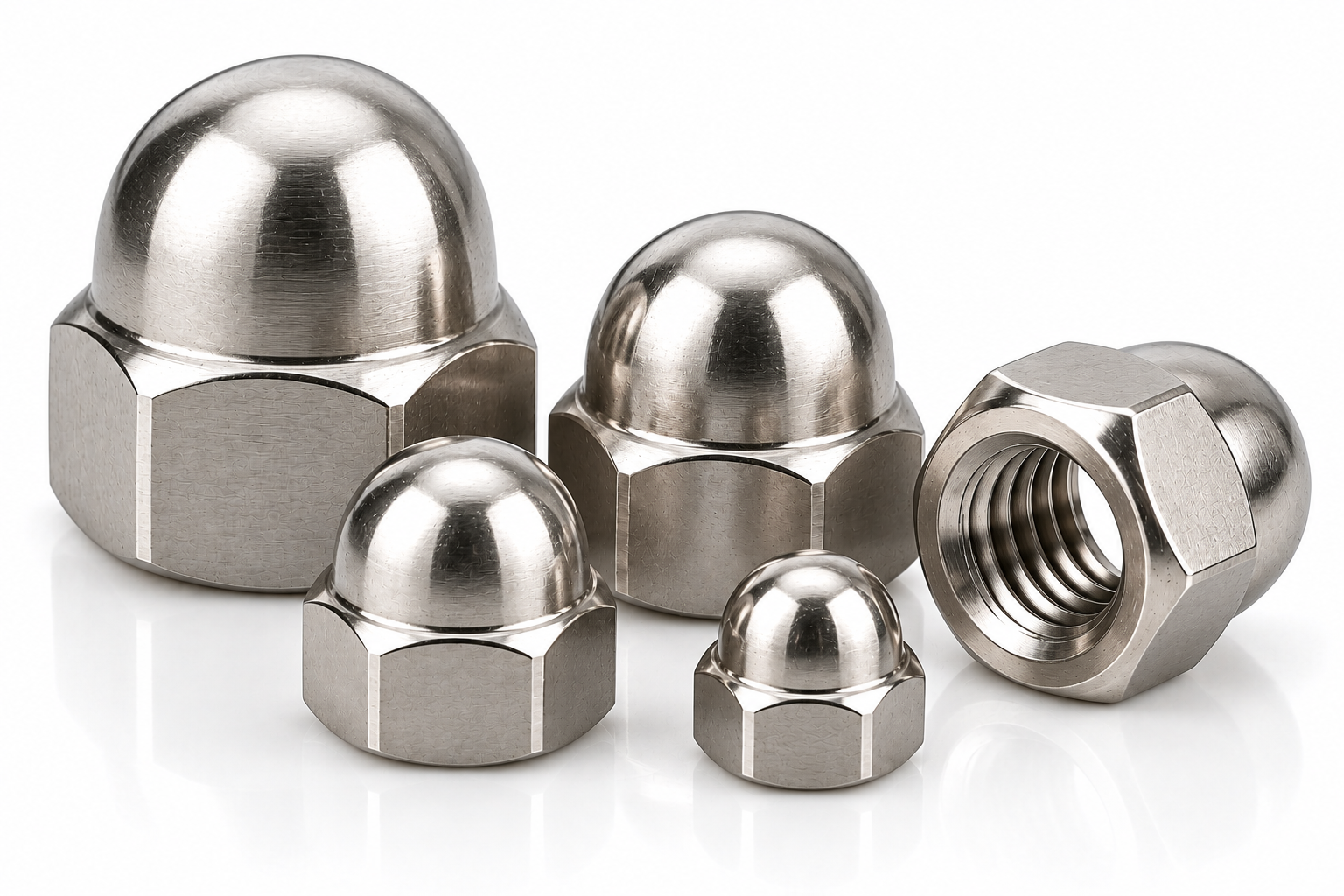
The DIN 1587 dome nut, also called an acorn or cap nut, combines a standard hexagonal driving profile with a closed domed crown that conceals and protects the exposed bolt end. Accurate Fastners manufactures these cold-forged nuts in stainless steel grades SS 202, SS 304 and SS 316 across the M5 to M12 diameter range.
- Standard
- DIN 1587
- Grades
- 304 / 316 / 202
- Size
- M5 – M12
- Length
- —
Overview
What is the DIN 1587 Dome Nut?
DIN 1587 is a German institute standard that defines the dimensional and geometric requirements for hexagon domed cap nuts — commonly known as acorn nuts. The standard specifies the relationship between the nominal thread diameter, the across-flats width of the hex body, and the height of the closed dome, ensuring interchangeability across manufacturers and compatibility with standard hexagon tooling. Accurate Fastners produces these nuts in conformance with DIN 1587 geometry using a cold-forging process.
The nut consists of two functional zones: a lower hexagonal body that accepts a spanner or socket, and an upper dome that is fully closed at its apex. The internal thread is blind — it runs through the hex body but does not penetrate the dome wall. When tightened onto a bolt or stud, the dome encloses the protruding thread end, preventing contact with surrounding surfaces or personnel and blocking ingress of moisture and contaminants at that exposed tip.
Cold forging gives the nut a refined grain structure and consistent dimensional accuracy without the material waste associated with machining. The external hex profile is retained from conventional hexagon nuts, so no special tooling is required for installation or removal. Available from M5 through M12, the range covers a broad span of light-to-medium assemblies where thread-end protection and a neat finished appearance are priorities alongside mechanical retention.
In Depth
Product description
Construction and Geometry
Each DIN 1587 dome nut is cold forged from stainless steel bar stock, producing a one-piece body in which the hexagonal section and domed crown are integral rather than joined. The across-flats dimension and overall height are governed by the DIN 1587 standard for each nominal metric thread size. The internal thread is formed as a blind bore — open at the base of the nut, closed beneath the dome — and cut to standard metric pitch for the given diameter.
The dome profile is rounded and symmetrical, rising above the hex body to a closed apex. This geometry serves a dual purpose: it encloses whatever thread length projects beyond the mating surface, and it presents a smooth, snag-free external silhouette. Wall thickness at the dome is maintained consistently during the cold-forging and threading operations, which helps preserve the structural integrity of the closed end throughout repeated assembly cycles.
Functional Behaviour in an Assembly
In a bolted joint, the dome nut functions identically to an ordinary hexagon nut in terms of clamping force generation — torque applied to the hex flats is converted to clamp load through the engaged thread length within the hex body. The blind dome adds no structural contribution to joint preload; its role is protective and aesthetic. Because the thread is blind, the usable thread engagement depth is fixed by the internal bore length, so the bolt or stud should not project so far that it bottoms out against the dome interior before adequate clamp load is achieved.
The closed dome also acts as a secondary barrier, reducing direct exposure of the bolt tip to the environment. In assemblies where the fastener head is accessible to incidental contact — such as enclosures, frames or consumer-facing equipment — the smooth dome eliminates sharp thread ends. Assembly and removal use standard metric spanners or sockets sized to the across-flats dimension specified by DIN 1587, keeping the process straightforward within existing maintenance toolkits.
How It Differs from Similar Fasteners
A standard hexagon nut is open at both faces, leaving the bolt thread fully exposed above the joint surface. A dome nut closes that upper face, distinguishing it immediately in applications where thread-end exposure is undesirable. Compared with a nylon-insert or all-metal prevailing-torque lock nut, the dome nut provides no inherent vibration-resistance feature — it relies on the same friction and preload mechanisms as a plain nut, and a separate locking method should be considered if vibration resistance is needed.
Slotted or castellated nuts accept a cotter pin through the bolt for positive locking; dome nuts do not, as the closed crown precludes cross-drilling. Flange nuts distribute load across a wider bearing area; dome nuts offer no such flange, concentrating the bearing load on the standard hex base face. Understanding these distinctions helps in selecting the dome nut specifically for its thread-concealment and appearance benefits rather than as a general-purpose locking or load-spreading solution.
Material & Grade
Material and grade information
- SS 304
- SS 316
- SS 202
Accurate Fastners supplies DIN 1587 dome nuts in three austenitic stainless steel grades: SS 202, SS 304 and SS 316. SS 304 is a widely used austenitic grade containing chromium and nickel, offering good general corrosion resistance and suitability across a broad range of indoor and moderate outdoor environments. SS 316 includes molybdenum, which typically improves resistance to chloride-containing environments compared with SS 304, making it a common consideration where exposure to moisture, cleaning agents or coastal conditions is expected.
SS 202 is a lower-nickel austenitic grade that substitutes manganese and nitrogen to maintain austenitic structure. It is generally considered more economical than SS 304 and may be appropriate for less demanding corrosion environments. Grade selection should account not only for the service environment but also for the material of mating components, since mixing dissimilar stainless grades can introduce galvanic considerations. Where there is uncertainty about the most suitable grade for a specific application, consultation with Accurate Fastners' sales team is recommended before placing an order.
Grades shown are those documented for this product in the Accurate Fastners brochure. General material notes are guidance only; confirm grade selection for your environment.
Technical Data
Technical specifications
| Product type | Nut – DIN 1587 Dome Nut |
|---|---|
| Material | Stainless steel |
| Material grade | SS 304, SS 316, SS 202 |
| Applicable standard | DIN 1587 |
| Nominal diameter / size | M5 – M12 |
| Thread type | Metric internal thread, blind |
| Head / form | Hexagon with closed domed cap (acorn) |
| Drive / tightening | External hex |
| Manufacturing process | Cold forged |
Sizes
Available sizes
Documented size range
M5 – M12
Documented length range
Not applicable
Individual sizes within the documented range, thread pitches and lengths are confirmed at quotation stage.
Applications
Industrial applications
RO Water Purifier Assemblies
Dome nuts may be used on frame members and panel fixings within RO water purifier units, where the closed dome helps keep exposed thread ends away from water-contact zones and internal components.
Solar Energy Mounting Structures
On solar panel mounting frames and racking hardware, dome nuts provide a neat finish on visible fastener points, reducing sharp protrusions that could cause handling injuries during installation or maintenance.
Pharmaceutical Machinery Enclosures
In pharmaceutical equipment housings, smooth external fastener profiles are often preferred. A dome nut eliminates protruding thread ends on guard panels and covers, supporting cleanroom-compatible surface standards.
Food and Beverage Equipment
On food-processing machinery guards or hoppers, dome nuts in SS 304 or SS 316 may help reduce crevices and thread-end projections, contributing to easier external cleaning of equipment surfaces.
LED Lighting Fixtures and Enclosures
Dome nuts used in LED luminaire assemblies and junction boxes provide a finished appearance on visible fastener locations and protect thread ends from contact with internal wiring or housing surfaces.
Featured for: Food & Beverage, Pharmaceutical Machinery
Features & Selection
Features and selection considerations
Design features
Closed Dome Crown
The fully enclosed dome conceals the projecting bolt or stud end, preventing contact with adjacent surfaces, wiring or personnel, and giving the assembly a cleaner visual finish.
Cold-Forged Construction
Cold forging refines the grain structure of the stainless steel, producing consistent dimensional accuracy and mechanical integrity throughout the hex body and dome wall without secondary machining operations.
Standard External Hex Drive
The hexagonal body conforms to DIN 1587 across-flats dimensions, accepting standard metric spanners and sockets so no specialised tooling is needed during assembly or maintenance.
Blind Internal Thread
The metric internal thread runs through the hex section and terminates before the dome, providing defined thread engagement while the closed apex protects the thread bore from contamination.
Three Stainless Steel Grade Options
Available in SS 202, SS 304 and SS 316, allowing selection based on corrosion environment, budget and compatibility with mating components across a range of industrial assembly contexts.
Before you order
Thread Diameter and Engagement Depth
Confirm that the bolt or stud nominal diameter falls within the M5–M12 range and that the projecting thread length does not exceed the internal bore depth, to avoid the fastener bottoming out before achieving the required clamp load.
Material Grade for Service Environment
Select SS 316 where chloride or moisture exposure is expected, SS 304 for general indoor or moderate conditions, and SS 202 for less demanding environments. Always verify grade compatibility with mating fasteners to avoid unintended galvanic pairing.
Mating Component Compatibility
Ensure the bolt, stud or insert is specified to a compatible metric thread standard and pitch. DIN 1587 dome nuts carry standard metric coarse pitches; confirm the mating thread specification when ordering to avoid mismatches on assembly.
Quantity and Documentation Requirements
For project or production orders, communicate required quantities, packaging preferences and any material traceability or quality documentation needs — such as test reports — at the enquiry stage to allow Accurate Fastners to prepare the appropriate supply package.
FAQs
Frequently asked questions
What is a DIN 1587 dome nut used for?
A DIN 1587 dome nut is used to terminate a bolted joint while enclosing the projecting thread end under a closed dome. It is typically chosen where thread-end protection, a snag-free profile or a neat finished appearance is required on the assembly.
Which stainless steel grades are available?
Accurate Fastners supplies DIN 1587 dome nuts in SS 202, SS 304 and SS 316. SS 316 typically offers improved chloride resistance due to its molybdenum content, while SS 304 suits general use and SS 202 is a more economical option for less corrosive environments.
What size range do you offer?
The dome nuts are available from M5 to M12 in metric thread diameters. This range covers many light-to-medium industrial assembly requirements. If you need sizes outside this range, please contact the sales team to discuss options.
Does the dome nut provide locking or vibration resistance?
No. The DIN 1587 dome nut relies on standard thread friction and joint preload like a plain hexagon nut. It does not incorporate a nylon insert, prevailing-torque feature or cotter-pin slot. If vibration resistance is needed, a separate locking method should be considered alongside it.
What standards does Accurate Fastners' quality control cover?
Accurate Fastners' quality control team performs checks during procurement and at delivery. The broader fastener range is produced in compliance with IS, BS and DIN standards. Specific documentation requirements for an order should be discussed at the enquiry stage.
How can I request a quotation or place an enquiry?
You can submit your requirements through the enquiry form on the website, send details by email to export@accuratefastners.com, or reach the team directly via WhatsApp. Please include the grade, diameter, quantity and any documentation requirements when making contact.
Related Products
Complementary fasteners
Request a Quote
Request a quote for DIN 1587 Dome Nut
Tell us the grade, diameter, length and quantity you need. Your enquiry will be pre-filled with this product name.